Museum-Quality Giclée Prints
Our giclée prints are crafted using archival pigment inks that resist fading and faithfully preserve the original tonalities and hues of the artwork.
No Watermarks or Branding
Your print will arrive free of any watermarks or branding—just the art, exactly as intended.
Sizing & Framing Details
-
Unframed Matte Paper Prints: Delivered in the exact dimensions of the artwork on 280 gsm Artist Paper.
-
Stretched Canvas: Ready to hang with neatly finished edges and solid wood support.
-
Framed Prints: Professionally mounted in a premium wood frame with backing and wire installed.
Fast, Free Shipping
Satisfaction Guaranteed
Enjoy peace of mind with our 30-day money-back guarantee. With over 15 years of experience in curating and reproducing fine art, we’re committed to exceptional craftsmanship and customer satisfaction.
Customer Reviews (Verified Buyers)
⭐️⭐️⭐️⭐️⭐️ "Love it! Arrived quickly."
⭐️⭐️⭐️⭐️⭐️ "Lovely painting and details are clear."
⭐️⭐️⭐️⭐️⭐️ "Great work on our Renoir."
⭐️⭐️⭐️⭐️⭐️ "Exceptional quality print."
About this work
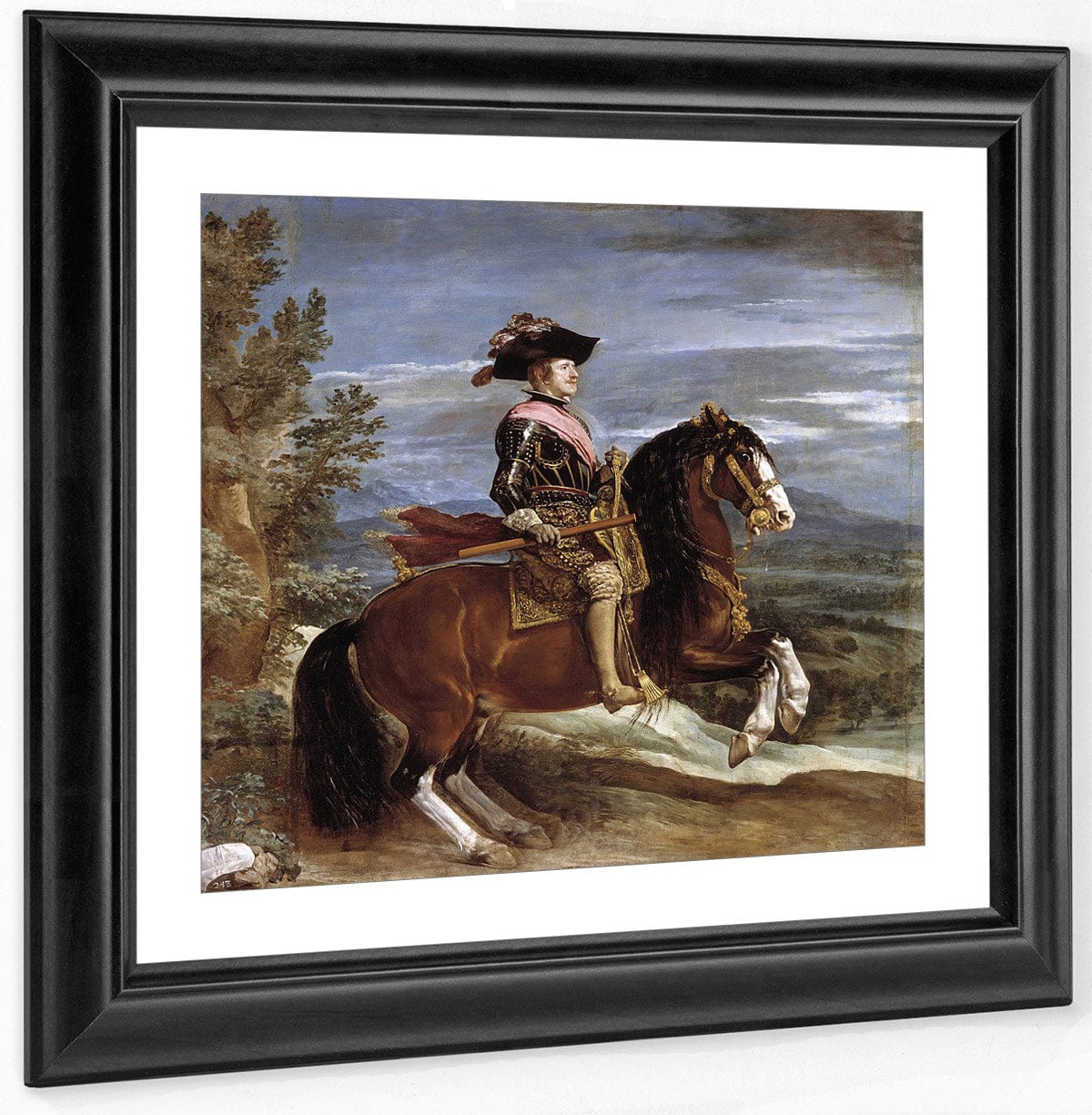
Here sits the Spanish king astride his mount, rendered with the unsentimental clarity that defines Velázquez's entire practice. Philip IV commands the composition from horseback—a traditional emblem of royal authority—yet there is nothing inflated or ceremonial in the painter's approach. The figure is presented with directness, the king's bearing dignified but not theatrical. Around him, Velázquez deploys his signature palette of warm ochres, deep shadows, and luminous grays, allowing light to articulate form rather than ornament it. The horse itself receives the same unflinching attention as the monarch; both are observed, not idealized. The landscape opens behind them, atmospheric and restrained, grounding the portrait in a tangible world rather than the flattery of court convention.
This painting exemplifies the singular bond between artist and patron that defined Velázquez's career. After impressing the young king with his first portrait in 1623, Velázquez became Philip's chosen portraitist—the only hand permitted to render his likeness. Over decades, he returned again and again to the challenge of capturing this particular man. The equestrian format allowed him to explore both power and presence without resort to theatrical gesture. This is the work of an artist in full command of his gifts, painting a subject he knew intimately across years.
On the wall, this portrait asks for a room of some intelligence—somewhere the subtlety of its execution can unfold. It speaks to those who recognize that true authority requires no bombast, that the greatest paintings often whisper rather than proclaim. Hung in natural light, it rewards prolonged looking.
About Diego Velazquez
Court painter to Philip IV of Spain and the defining eye of the Spanish Golden Age, he turned royal portraiture into something quietly radical. Working in Madrid from 1623 until his death in 1660, he developed a loose, optical brushwork that suggested form rather than describing it - a technique Manet would later credit as the foundation of modern painting. His portraits of the Infantas, painted in the same years he produced Las Meninas, treat children of the Habsburg court with a candor unusual for the period.
For a contemporary viewer, his pictures still feel startlingly alive: present, observant, never sentimental.